Build Privacy Around the Space a Hedge Will Eventually Need
The urge to plant the fastest shrub available is understandable when a neighbor's window overlooks your patio or a bare boundary makes the garden feel exposed. Yet a privacy hedge succeeds only when its mature height, width, seasonal foliage, and maintenance needs fit the place where it grows. A shrub that quickly fills a narrow strip can just as quickly block a path, shade a vegetable bed, or require repeated cutting to stay within the property. Start by identifying the view you want to interrupt, then measure the planting area and assess sunlight, drainage, and regional suitability. Fast growth is useful when it produces a healthy, manageable screen. It becomes expensive when it forces a large plant into a small role. The strongest choices combine reasonable establishment speed with a mature form you can accommodate, whether that means an evergreen boundary, a summer screen, or a mixed planting that gives privacy without becoming a continuous clipped wall.
A: Check the cultivar's mature width and height, leaving room for maintenance access and locally appropriate boundary clearances.
A: Not necessarily; deciduous hedges lose leaves, so judge the winter view separately before relying on their summer density.
A: No, elevated views can pass above boundary foliage; test screen placement from the occupied area as well as height.
A: No, colorful stems contribute winter structure but do not supply the concealment of a suitably dense evergreen hedge.
A: No, their smaller mature height limits the final screen even when compact cultivars make useful vigorous growth.
A: Other suitable plants can continue providing some screening while the affected species is assessed and its problem addressed.
A: No, use suitable spacing and a separate temporary screen instead of creating future crowding for immediate leafy enclosure.
A: No, verify its regional climate suitability before choosing a warm-region shrub for a garden with cold winters.
A: Evaluate mature height, pruning response, working access, and whether keeping the desired outline requires special equipment or professional help.
A: Adjust the layout, choose a smaller suitable cultivar, or combine appropriate structural screening with a manageable shrub planting.
Find the Sightline Before Setting the Hedge Height
Stand where privacy is needed and look toward the actual source of exposure. A sitting area may need a relatively modest screen, while an elevated neighboring window creates a different geometry. A tall hedge beside the fence may still leave that elevated view open because the sightline passes above it. Temporarily mark candidate positions and heights with simple stakes or a movable screen. This helps you judge whether shrubs along the entire boundary are necessary or whether a smaller planting nearer the seating area would achieve the purpose.
Think about the seasons when the space is used. A leafy deciduous hedge can work beautifully beside a summer patio yet provide little visual enclosure after leaf fall. An evergreen may answer a winter need, but only if its climate requirements and mature size fit. Dense branches can soften a view without fully concealing it, and flowering shrubs can provide an attractive partial screen. Define the desired degree of privacy before treating every gap as a problem that requires the largest possible plant.
Treat Mature Width as a Buying Requirement
A nursery shrub's small container gives little indication of the ground it may occupy later. Read the mature dimensions for the exact species and cultivar, then allow space for its natural outline and your chosen pruning approach. The planting strip must accommodate foliage on both sides, access for maintenance, and appropriate clearance from structures. A broad shrub squeezed between a walkway and a fence will not become narrow simply because it is advertised for hedging. Choosing a genuinely smaller selection can reduce both labor and future replacement costs.
Spacing depends on that mature form and the intended screen. Very close planting may produce an early impression of fullness while creating crowding as roots and branches develop. Excessively wide spacing can leave openings for longer than expected. Use locally appropriate recommendations for the specific plants rather than one universal distance for all hedges. Mark the proposed positions before purchasing and imagine their developed width, including any spread by suckers. A screen can be informally continuous without every young shrub touching immediately.
Where the bed is too narrow, reconsider the arrangement instead of relying on constant severe pruning. A suitable fence with a modest planted border may supply immediate privacy more realistically than a hedge that cannot fit. You might shift the screen inward, use a shorter section around the occupied space, or select a different mature height. Check local boundary rules and utilities before planting or constructing anything. The garden will be easier to care for when the design respects the available dimensions from the beginning.
Use Ninebark Where a Broad Summer Screen Fits
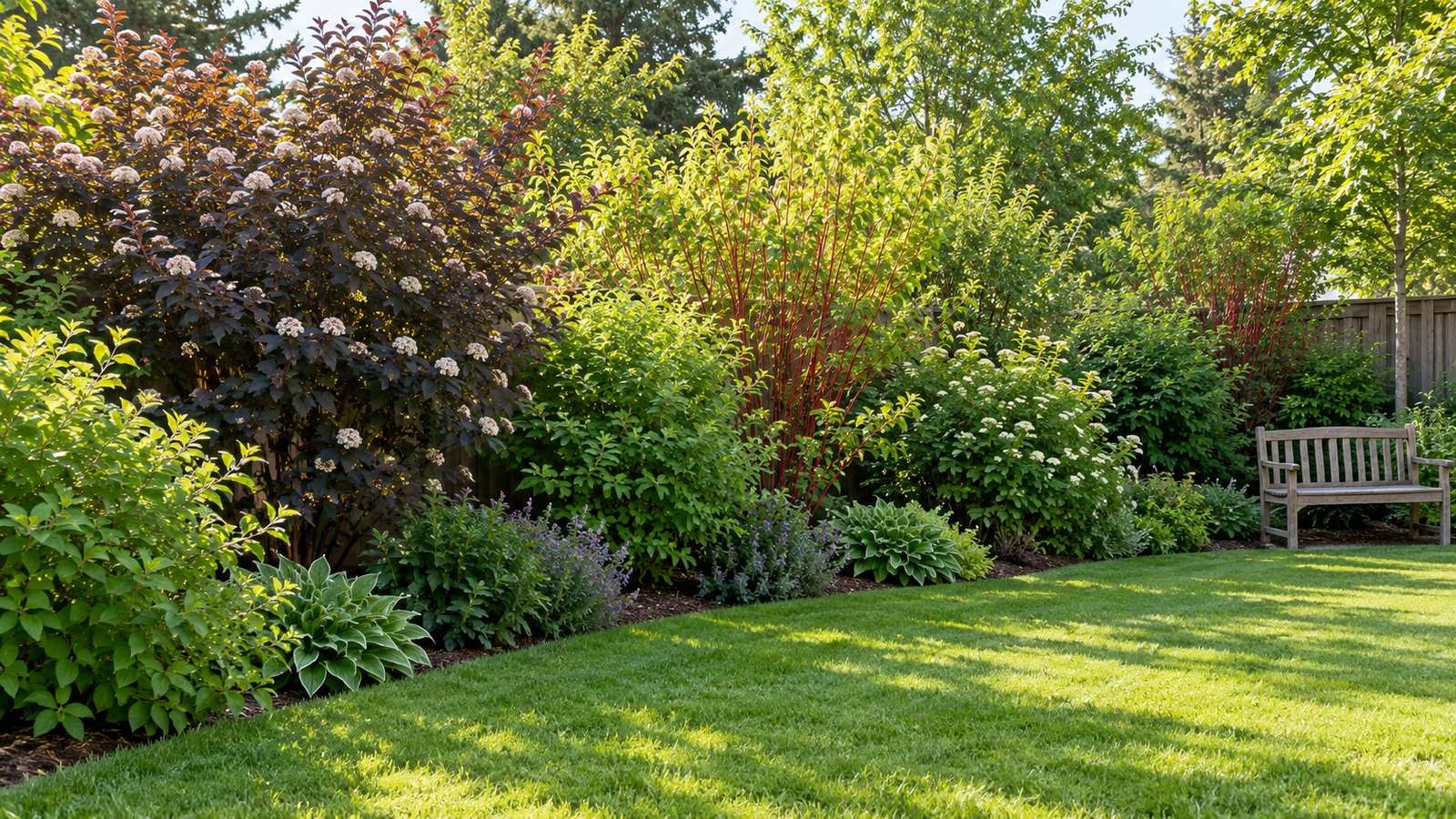
Common ninebark, Physocarpus opulifolius, is a deciduous North American shrub that can form a substantial informal hedge in suitable regions. Its branching habit, foliage, and spring flowers make it useful where a broad summer screen is welcome. Named cultivars differ considerably in size and leaf color, so buying an unidentified ninebark is a poor substitute for checking a specific selection. Some compact cultivars may suit smaller beds but cannot be expected to provide the height of a full-sized plant. Allow for the actual mature width and remember that its leaves do not supply winter opacity.
Choose a site and cultivar according to regional guidance, soil conditions, and available sun. Ninebark's reputation for adaptability does not mean every selection performs equally in every climate or neglected planting strip. Watch establishment growth before deciding how much shaping is needed. An informal form often shows its character better than repeated shearing into a tight rectangular wall. If renewal pruning is appropriate later, plan it so the hedge does not lose all of its screening at once. Retaining a balanced mixture of younger and older growth can help preserve the planting's usefulness.
Consider Red-Twig Dogwood for Moist Sites and Winter Structure
Red-twig dogwood, Cornus sericea, is another deciduous candidate where climate, moisture, and mature spread are suitable. It can grow vigorously and create a leafy seasonal boundary, while colored stems provide winter interest after the leaves fall. That stem display should not be confused with a solid winter privacy barrier. Some selections spread or sucker, which may be useful in a generous bed but troublesome beside a narrow path. Match the cultivar to the space and account for renewal pruning when judging how consistently the hedge will screen the view.
Choose Evergreen Candidates by Region Rather Than a Speed Ranking
Evergreen shrubs are valuable when the garden needs screening throughout the year, but evergreen status alone says nothing about climatic fit. Cold hardiness, summer heat, soil moisture, wind exposure, and available light all affect the choice. Ask a local extension service or knowledgeable nursery for suitable hedge shrubs with dimensions you can accommodate. Check whether a proposed plant is actually a large tree sold while young. A fast-growing tree can become a very different boundary feature from the shrub hedge imagined at purchase.
Southern wax myrtle, Morella cerifera, illustrates why regional context matters. It can provide evergreen screening in suitable warm regions, particularly where its environmental requirements are met, but it is not a universal replacement for cold-climate hedges. Its mature habit can become substantial, and pruning expectations should reflect the form you want. Other regions will have different appropriate evergreen choices. Treat recommendations as candidates to evaluate locally rather than a national shopping list that ignores winter conditions or available root space.
Be cautious about a familiar hedge species whose rapid spread causes problems outside gardens. Invasive status varies by region, and the relevant local list should be checked before buying. A plant that easily escapes cultivation may create a larger problem than the privacy gap it solves. Also examine pest and disease concerns for common local choices. The best evergreen hedge is the one that can remain healthy and appropriately sized in your area, not the one with the largest advertised annual growth figure.
Let a Mixed Screen Share the Work
A mixed shrub screen can spread risk and add visual interest along a long boundary. Combine plants that suit the same site while differing in foliage, flowering season, or branching character. Repetition within the mixture keeps the composition coherent; a separate specimen at every position can look busy and make care more complicated. Include enough evergreen material where winter privacy matters, and place seasonal flowering shrubs where their contribution is most useful. A mixed screen still needs a realistic width rather than becoming an excuse to crowd several incompatible plants together.
Different growth rates require deliberate placement and occasional adjustment. A vigorous shrub should not overwhelm a slower neighbor that provides essential winter foliage. Allow access to inspect each plant and avoid burying irrigation problems inside a dense tangle. If one species develops a serious problem, the entire screen may remain more functional than a boundary made from a single vulnerable choice. That resilience is useful, but it does not eliminate maintenance. The planting succeeds when its parts share the screening role without competing beyond the space available.
Help New Shrubs Establish Before Demanding a Wall
Prepare the planting area by assessing drainage, soil condition, and competing weeds before installation. Follow appropriate guidance for planting depth and root preparation, and water the root zone according to actual moisture rather than a rigid daily schedule. Keep mulch away from stems while using it appropriately over the bed. Small well-selected plants can establish effectively, but they need time to develop roots and branches. A promise of fast growth cannot replace adequate water, suitable planting conditions, or patient monitoring during the first growing seasons.
Larger nursery plants can provide more immediate presence, yet they may cost more and still need careful establishment. Evaluate root condition and plant quality instead of buying solely by height. A tall sparse shrub is not automatically a better screen than a smaller branched one. Protect young plants from the specific pressures at the site, such as browsing or strong drying winds, using suitable measures where needed. Track healthy new growth and soil moisture before adding fertilizer in the hope of forcing a faster result.
If privacy is urgent, provide an appropriate temporary or structural solution while the shrubs develop. This can let you choose a manageable mature hedge rather than overplanting to conceal the view immediately. Check that temporary screening will not shade the new plants excessively or interfere with access and watering. Remove or adjust it as the planting grows. A staged approach acknowledges the difference between a newly installed garden and a mature landscape while protecting the long-term quality of the screen.
Prune for Density Without Turning Care Into a Struggle
Pruning methods depend on the shrub and the intended form. An informal flowering hedge often needs selective thinning or renewal rather than frequent surface shearing. A clipped hedge requires a species that tolerates that treatment and a shape that lets light reach lower foliage. Cutting every shrub by the same calendar can remove flower buds or damage plants that do not regrow from old bare wood. Learn the response of each selected species before treating the hedge as a uniform green structure. Keep a simple record of when work was done and how the plants responded. This can reveal whether the chosen routine preserves useful cover or repeatedly leaves the same boundary exposed at an inconvenient time. Inspect growth from both accessible sides, because a hedge that looks dense from the patio may have a neglected interior or fence-facing edge. Adjust the care plan gradually using the plant's health and the desired sightline as guides, rather than removing large amounts simply to make every shrub look identical.
Allow working room and choose a height you can maintain safely. A very tall clipped screen may require professional equipment and recurring expense, even if the plants themselves were inexpensive. Inspect for bare bases, crowding, damaged branches, and changes in the screened view as the garden develops. Correct small problems before they become a reason for drastic cutting. Maximum useful privacy comes from a healthy hedge at an appropriate scale, supported by care you can sustain over many years.
Choose Screening Plants With Local Guidance
Review extension guidance on mixed privacy screens alongside local plant recommendations. Find practical garden tools and supplies through Garden Product Reviews.