Few gardens capture the romance of the English countryside quite like Sissinghurst Castle Garden. Hidden among the fields and farmland of Kent in southeastern England, Sissinghurst is a landscape of contrasts: formal hedges surrounding exuberant flowers, narrow pathways opening into secret garden rooms, weathered brick walls covered in climbing plants, and carefully controlled color schemes that somehow still feel wonderfully natural. Its distinctive character was largely shaped during the 20th century by writer and poet Vita Sackville-West and her husband, diplomat and author Harold Nicolson. Together, they transformed a neglected historic property into one of the world’s most influential gardens. Nicolson provided much of the architectural structure and geometry, while Sackville-West filled those spaces with romantic, abundant planting. Their collaboration created a garden that appears spontaneous but is actually held together by strong design. Sissinghurst became especially famous for its White Garden, but its influence reaches much further. Modern ideas about garden rooms, restrained color palettes, romantic planting, hedged enclosures, and combining formal structure with informal flowers all owe something to the style Sissinghurst helped popularize.
A: It is located in Kent, England, and is one of the country's best-known historic gardens.
A: Vita Sackville-West and Harold Nicolson developed the garden after acquiring the property in 1930.
A: It is especially known for its garden rooms, romantic planting, historic tower, Rose Garden, and iconic White Garden.
A: It is a garden room planted mainly with white flowers, silver foliage, and green structural plants.
A: Harold Nicolson was largely responsible for the formal framework of paths, hedges, axes, and garden rooms.
A: Vita Sackville-West played the leading role in developing the lush, romantic planting style associated with Sissinghurst.
A: Yes. Start with strong boundaries or hedges, create separate garden rooms, and fill them with layered perennials, roses, climbers, and shrubs.
A: No. Even a small yard can use screens, hedges, fences, or trellises to create intimate rooms and framed views.
A: Try a limited color palette in one bed, such as white flowers with silver foliage, surrounded by strong green structure.
A: The magic comes from contrast: formal geometry creates order, while abundant planting creates softness, romance, and movement.
Where Is Sissinghurst Castle Garden?
Sissinghurst Castle Garden is located near the village of Sissinghurst in Kent, a county famous for orchards, farmland, historic estates, and beautiful countryside. Kent’s long gardening tradition and relatively mild climate helped make the region particularly suitable for the type of abundant planting that would eventually characterize Sissinghurst. The property itself is not a conventional castle surrounded by enormous defensive walls. Instead, it contains surviving historic buildings and architectural fragments from different periods, including the distinctive Elizabethan tower that has become one of Sissinghurst’s most recognizable landmarks. These weathered structures provide an extraordinary backdrop for the gardens. Brick walls, old doorways, courtyards, towers, and paths give the landscape a sense of history that newly created gardens often struggle to reproduce.
Sissinghurst Before Vita Sackville-West
The history of Sissinghurst stretches back centuries before its famous 20th-century transformation. The property developed through different periods of English history and experienced changing uses, owners, prosperity, and decline. By the time Vita Sackville-West and Harold Nicolson encountered Sissinghurst in 1930, the estate was far from the polished garden destination visitors know today. Buildings required attention, the landscape was overgrown, and the property presented enormous challenges. Yet Sackville-West saw possibilities within the ruins, walls, courtyards, and neglected land. Instead of viewing its age as a problem to erase, the couple used the surviving architecture as the foundation for something new. That decision became crucial to Sissinghurst’s character. The garden would not attempt to hide history. It would grow around it.
Who Was Vita Sackville-West?
Vita Sackville-West was an English writer, poet, novelist, journalist, and passionate gardener. Born in 1892, she grew up at Knole, an enormous historic house in Kent that profoundly influenced her imagination and sense of place. Because of inheritance traditions of the era, Sackville-West could not inherit Knole despite her deep attachment to it. The loss remained emotionally significant throughout her life. Sissinghurst eventually offered her an opportunity to create a place of her own. Although very different from Knole, the property possessed the age, atmosphere, and architectural drama that appealed to her. Sackville-West’s literary sensibility strongly influenced her gardening. She thought about plants in terms of color, atmosphere, romance, association, and emotional impact rather than merely botanical arrangement.
Harold Nicolson and the Other Half of Sissinghurst
Although Sissinghurst is frequently associated primarily with Vita Sackville-West, Harold Nicolson was essential to its design. Nicolson favored order, geometry, clear pathways, axes, hedges, and carefully defined spaces. His approach provided the framework within which Sackville-West’s abundant planting could flourish. This contrast became one of the garden’s greatest strengths. Without Nicolson’s structure, the planting might have become visually chaotic. Without Sackville-West’s romantic approach, the geometry might have felt too rigid. Together, they created a landscape in which disciplined architecture and exuberant plants constantly interact.
Buying Sissinghurst in 1930
Vita Sackville-West and Harold Nicolson purchased Sissinghurst in 1930. The property required imagination from the beginning. Rather than acquiring a finished estate, they took on a landscape that needed restoration and reinvention. Old walls and buildings divided the property naturally, suggesting opportunities for separate garden spaces. The couple gradually developed these areas into what would become Sissinghurst’s famous garden rooms. Instead of clearing everything and imposing one enormous design across the entire property, they worked with the existing architecture. This allowed Sissinghurst to develop an intimate scale despite the broader estate surrounding it.
The Revolutionary Idea of Garden Rooms
One of Sissinghurst’s most influential features is its organization into separate garden rooms. Hedges, brick walls, buildings, pathways, and openings divide the landscape into distinct spaces, each with its own atmosphere and planting identity. Walking through Sissinghurst is therefore a process of discovery. Visitors do not stand at the entrance and see the entire garden immediately. They pass through openings and along pathways before discovering another enclosed space. One room might emphasize roses, another herbs, another white flowers, and another a completely different combination of plants. This design strategy creates mystery while making the garden feel larger. Garden rooms have since become an enormously popular concept in residential landscape design because the principle works even on relatively small properties.
Formal Structure Meets Romantic Planting
The defining design secret of Sissinghurst is the contrast between formal structure and informal planting. Straight paths, clipped hedges, brick walls, and carefully positioned openings provide a disciplined framework. Inside those boundaries, flowers can appear generous, layered, and almost overflowing. Roses tumble over walls. Perennials crowd together in borders. Climbers soften architecture. Plants spill toward paths rather than remaining confined to perfectly separated rows. This controlled abundance gives Sissinghurst its unmistakable romantic character. The garden never feels truly wild because the underlying geometry remains visible, but it never feels sterile because plants soften almost every formal edge.
The Famous White Garden
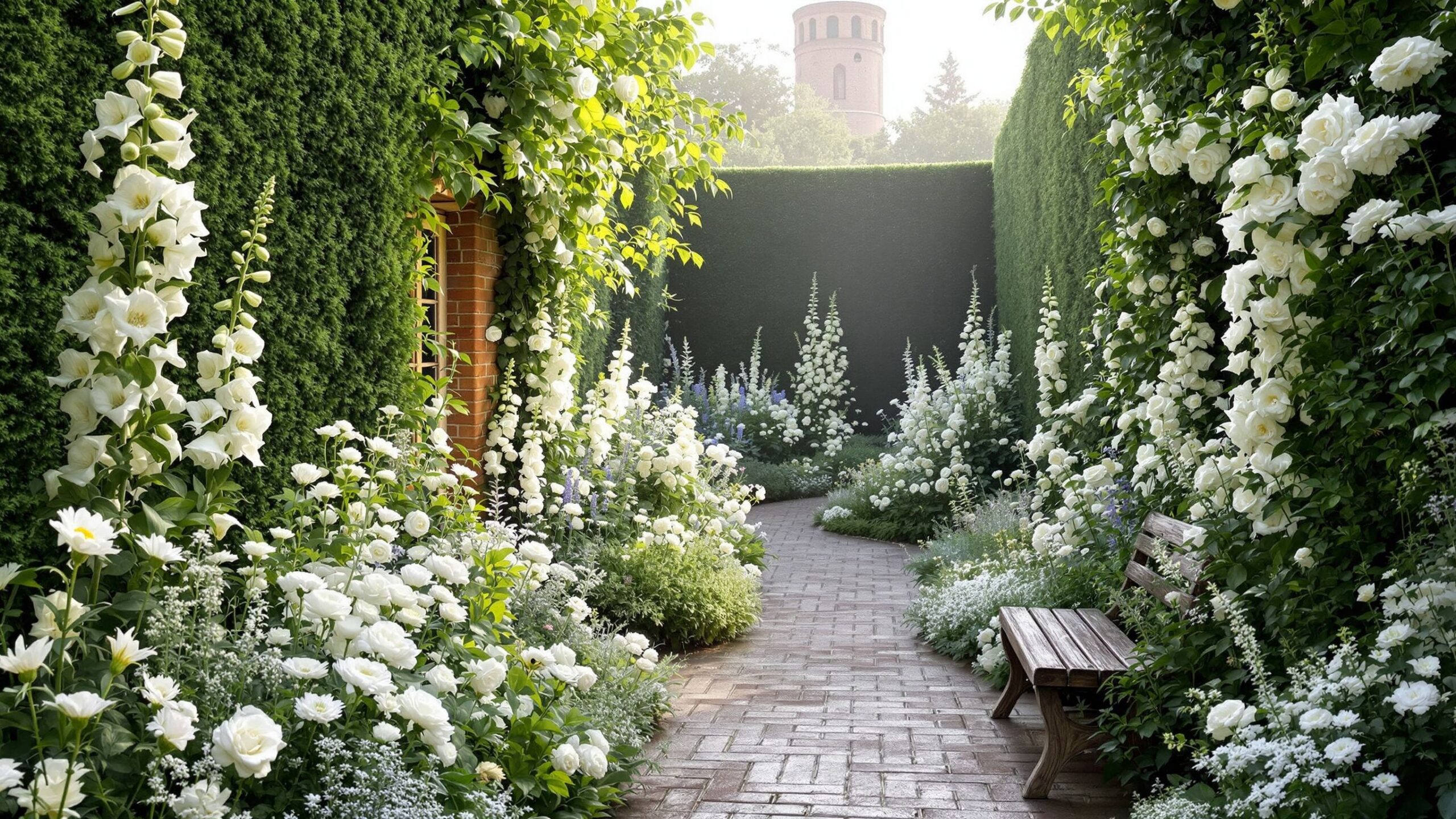
Sissinghurst’s White Garden is arguably its most famous creation and one of the most influential individual garden spaces of the 20th century. Rather than filling the area with every possible flower color, Sackville-West developed a restrained palette centered on white flowers and silvery, gray, and green foliage. The limitation created extraordinary visual unity. White roses, pale blossoms, silvery leaves, and textured greenery combine to produce a garden that changes with light and season without relying on strong color contrast. The White Garden demonstrated that restricting a color palette can actually make planting more dramatic.
Why the White Garden Became So Influential
The concept of a monochromatic garden was not entirely unprecedented, but Sissinghurst helped make the idea famous among generations of gardeners. White gardens began appearing in private landscapes around the world, often inspired directly or indirectly by Sackville-West’s example. The secret is that a white garden is not truly colorless. Different shades of green, silver, cream, ivory, and gray create subtle variation. Leaf shapes become more noticeable because bold flower colors are not competing for attention. White flowers also respond beautifully to changing light, glowing during early morning, evening, and overcast conditions.
The Rose Garden
Roses were another important part of Sackville-West’s gardening style. Sissinghurst’s Rose Garden became known for old-fashioned roses and richly layered planting rather than rigid rows of isolated rose bushes. Roses mingle with companion plants, creating combinations of fragrance, foliage, flower form, and color. Many historic roses bloom differently from modern repeat-flowering varieties, making their seasonal display particularly precious. Sackville-West appreciated plants with character and history, and roses fit naturally into the romantic atmosphere of Sissinghurst. Their ability to climb walls, arch over supports, and mingle with perennials helped blur the boundaries between architecture and planting.
The Cottage Garden
The Cottage Garden provides a warmer contrast to the cool restraint of the White Garden. Here, the planting traditionally emphasizes fiery and rich colors such as orange, yellow, red, and copper. The result demonstrates another important Sissinghurst principle: individual garden rooms can have completely different personalities while still belonging to the same overall landscape. A homeowner does not need to choose one color palette for an entire property. Different spaces can create different emotional experiences as long as each one has a clear identity.
The Herb Garden
Herbs contribute another layer to Sissinghurst’s mixture of beauty and usefulness. Historic gardens frequently combined ornamental and practical plants, and herbs naturally connect the landscape to centuries of culinary and medicinal gardening traditions. Their fragrances, textures, flowers, and foliage make them visually valuable as well. Lavender, sage, thyme, rosemary-like forms, and other aromatic plants can provide sensory experiences that go beyond appearance. Visitors do not simply see the garden; they encounter fragrance released by sun-warmed foliage and plants brushed while walking along paths.
The Orchard and More Naturalistic Spaces
Not every area of Sissinghurst depends on tightly controlled formal planting. Orchards, lawns, and more relaxed areas provide visual relief from enclosed garden rooms. This contrast is essential. If every section contained intensely planted borders, the landscape could become exhausting. Open spaces allow visitors to reset before entering another detailed garden. Mature trees also introduce height, shade, seasonal blossom, fruit, and a sense of age. The combination of formal gardens and more naturalistic landscapes makes the property feel connected to the surrounding Kent countryside.
The Tower at Sissinghurst
The Elizabethan tower is one of Sissinghurst’s most recognizable architectural features and plays an important role in the garden’s identity. Vita Sackville-West used the tower as a private writing space, strengthening the connection between her literary life and the landscape below. From above, the garden’s structure becomes especially clear. Hedges, pathways, garden rooms, lawns, and buildings form an organized composition that may feel much less formal when experienced at ground level among overflowing flowers. This contrast reveals the intelligence of the design. What feels romantic and spontaneous while walking through the garden is supported by an extremely strong underlying plan.
A Writer’s Approach to Gardening
Sackville-West did not approach gardening solely as a professional landscape architect might. She brought a writer’s imagination to plants. Flowers could create moods, suggest memories, or become characters within a larger composition. She also wrote extensively about gardening, sharing observations and advice with a wide audience. Her gardening columns helped extend her influence far beyond Sissinghurst itself. Readers who might never visit Kent could experiment with her planting ideas at home. In this way, Sissinghurst became influential not only because people physically experienced it but because its creator actively communicated her philosophy.
Plants Chosen for Personality
One of the most appealing aspects of Sissinghurst is the sense that plants were selected for character rather than uniform perfection. Sackville-West appreciated dramatic climbers, fragrant flowers, historic roses, unusual foliage, and plants capable of creating atmospheric combinations. Rather than relying entirely on perfectly matched bedding displays, she layered plants with different heights, textures, and forms. Tall flowers could rise above lower companions, while climbers created vertical interest against walls. This layering remains one of the easiest Sissinghurst-inspired techniques for home gardeners to recreate.
The Importance of Vertical Gardening
Old brick walls, buildings, arches, and other structures gave Sissinghurst countless opportunities for vertical planting. Climbing roses, vines, and other plants could cover surfaces that might otherwise remain visually empty. Vertical growth also makes a garden feel more immersive because flowers surround visitors at different heights instead of remaining entirely below waist level. Homeowners with small gardens can use the same technique. A climbing rose over an entrance, clematis on a trellis, or vine covering a fence can create abundant planting without requiring additional ground space.
Color as a Design Tool
Sackville-West’s approach to color remains one of the most useful lessons from Sissinghurst. Instead of treating every flower color as equally desirable everywhere, individual spaces were given deliberate palettes. The White Garden demonstrates the power of restriction, while warmer garden areas show how concentrated colors can create atmosphere. Home gardeners can achieve similar results by selecting two or three dominant flower colors for a particular bed rather than buying plants individually without considering how they will interact. Repeating those colors throughout the space creates rhythm and unity.
Paths That Create Mystery
Pathways at Sissinghurst do more than move visitors efficiently through the garden. They control what can be seen and when. A path may disappear through a hedge opening or pass beside a brick wall before revealing another garden room. This creates anticipation. The visitor wonders what is around the corner. Residential gardens can use the same strategy. Even a small curved pathway partially hidden by shrubs can make a backyard feel more intriguing. When every part of a garden is visible immediately, there is little reason to explore.
Doorways, Openings and Framed Views
Openings between Sissinghurst’s garden rooms function almost like doorways inside a house. A clipped hedge may contain a narrow entrance perfectly aligned with a tree, sculpture, building, or distant view. These framed scenes make transitions between spaces feel deliberate. Garden designers sometimes call these visual axes or sightlines, but the concept is simple: decide what you want someone to see when they look through an opening. At home, a gate can frame a flowering tree, an arbor can surround a distant bench, or a break between shrubs can reveal an attractive view.
Why Sissinghurst Feels Larger Than It Is
Dividing a garden might seem as though it would make the property feel smaller, but Sissinghurst demonstrates the opposite. Because visitors cannot see everything at once, they mentally imagine more landscape beyond each hedge or wall. Every new opening reveals another space. This sequence creates a feeling of abundance and complexity. The technique is especially valuable for small suburban gardens. Screening portions of the yard with hedges, shrubs, trellises, or fences can create multiple destinations and make the landscape feel significantly larger.
Sissinghurst Through the Seasons
Like all great gardens, Sissinghurst changes constantly. Spring introduces bulbs, fresh foliage, flowering trees, and early perennials. Roses and abundant borders transform the garden as the growing season progresses. Summer creates the lush, overflowing appearance most strongly associated with the property. Autumn shifts attention toward foliage, seed heads, fruit, and changing light. Winter exposes the garden’s underlying architecture. Hedges, walls, paths, trees, and buildings become more prominent when flowers disappear. This seasonal transformation demonstrates why strong structure is essential in a garden famous for flowers.
What Happens When the Flowers Are Gone?
The true test of garden design often comes during winter. Without abundant flowers distracting the eye, weak structure becomes obvious. Sissinghurst succeeds because its bones remain strong. Brick walls provide color and texture. Evergreen hedges maintain the geometry of garden rooms. Pathways continue establishing direction. Trees and buildings provide vertical structure. Home gardeners can use the same principle by designing the permanent framework first and treating flowers as an additional layer rather than the entire garden.
The National Trust and Sissinghurst’s Preservation
Sissinghurst Castle Garden eventually came under the care of the National Trust, helping ensure its preservation for future generations. Maintaining a historic garden presents unusual challenges because plants are living materials. A historic chair can be carefully conserved, but a rose eventually declines. Trees die, hedges need replacement, diseases appear, and climate conditions change. Preserving Sissinghurst therefore requires interpreting historic intentions while continually making horticultural decisions. The goal is not to freeze the garden permanently but to protect its character while allowing it to remain alive.
The Challenge of Preserving a Living Work of Art
Every famous historic garden faces a difficult question: what exactly should be preserved? Individual plants cannot live forever. Gardeners must decide when to replace them, which varieties best reflect the original design, and how much natural evolution should be allowed. At Sissinghurst, preservation involves historical research as well as practical horticulture. Old photographs, planting records, writings, and other evidence can help guide decisions. Yet today’s gardeners must also respond to modern environmental conditions. This makes historic garden conservation an ongoing conversation between past and present.
How Sissinghurst Changed English Gardening
Sissinghurst’s influence can be seen throughout modern garden design. The concept of garden rooms became widely adopted. Monochromatic gardens gained popularity. Romantic planting contained within formal structure became a defining feature of what many people now imagine as classic English garden style. The combination of old roses, abundant perennials, clipped hedges, brick walls, and secret pathways has inspired countless residential landscapes. Even gardeners unfamiliar with Sissinghurst may unknowingly use ideas it helped popularize.
How to Recreate the Sissinghurst Look at Home
The most important step is establishing structure before choosing dozens of flowers. Determine where pathways should travel and whether hedges, fences, trellises, or shrubs could divide the property into smaller spaces. Create one or two strong garden rooms rather than attempting to reproduce the entire estate. Give each area a clear identity. One might become a white garden, while another could emphasize roses and soft pastel perennials. Use vertical structures for climbing plants and allow some flowers to spill naturally toward pathways. The goal is controlled abundance, not disorder.
Create Your Own White Garden
A Sissinghurst-inspired white garden can work beautifully beside an entrance, patio, fence, or shaded seating area. Begin with green foliage as the foundation, then introduce white flowers in different shapes and heights. Add silver or gray foliage to create additional contrast. White roses, hydrangeas, foxgloves, cosmos, peonies, alliums, tulips, and other locally suitable plants can contribute to the effect depending on climate. Avoid relying on one type of flower. The magic comes from combining foliage, texture, height, and different shades of white and cream.
Combine Formal Hedges With Loose Flowers
One of the easiest ways to capture Sissinghurst’s character is to create contrast. Use a neatly clipped hedge along the edge of a planting bed, then fill the space behind it with looser flowers. The hedge creates a visual boundary that allows the planting to become more exuberant without appearing neglected. This principle works with boxwood alternatives, evergreen shrubs, low fencing, stone edging, or even carefully maintained lawn edges. Structure gives freedom to the plants inside it.
Add Old-Fashioned Roses
Roses instantly contribute to the romantic English garden atmosphere associated with Sissinghurst. Look for varieties with fragrance, interesting flower forms, and growth habits suited to your space. Climbing roses can transform fences, arches, walls, and pergolas. Shrub roses can mingle with perennials rather than standing alone. Combine roses with plants that flower at different times so the garden remains interesting after the main rose season ends.
Make the Entrance Part of the Garden
At Sissinghurst, architecture and plants constantly interact. Homeowners can recreate this relationship by treating the entrance to the house as part of the landscape rather than stopping flower beds several feet away. Climbing plants can frame a doorway, containers can soften steps, and flowering beds can guide visitors toward the entrance. Weathered brick, stone, natural wood, and traditional garden materials work especially well with romantic planting.
Let the Garden Mature
Sissinghurst’s atmosphere cannot be recreated instantly because much of its beauty comes from age. Mature climbers cover walls, hedges have substantial presence, and plants interact naturally after years of growth. Home gardeners should resist the temptation to overcrowd new beds simply because young plants initially look small. Give shrubs and perennials room to mature. Allow vines to establish themselves gradually. A garden that improves over five, ten, or twenty years will ultimately feel more authentic than one designed to appear completely finished on installation day.
Lessons From Vita Sackville-West’s Garden
Sissinghurst teaches that a garden can be both disciplined and romantic. It can contain straight lines and overflowing roses, carefully clipped hedges and self-seeding flowers, deliberate color palettes and unexpected combinations. These apparent contradictions are what make the garden memorable. The greatest lesson is not to copy every plant Vita Sackville-West grew. It is to understand the balance she and Harold Nicolson created between structure and freedom. The framework gives the garden clarity. The plants give it personality.
Why Sissinghurst Castle Garden Remains Famous
Many beautiful gardens have been created since Vita Sackville-West and Harold Nicolson began transforming Sissinghurst in 1930, yet their garden remains extraordinarily influential. Part of its appeal comes from the personalities behind it, part from its historic architecture, and part from the planting itself. But perhaps the greatest reason is that Sissinghurst feels achievable in spirit. Few people can recreate Versailles, but almost anyone with a garden can experiment with a restricted color palette, plant a climbing rose, frame a view, create a hidden seating area, or divide a yard into smaller rooms. Sissinghurst translates grand landscape thinking into intimate human-scale experiences.
A Garden Where Literature and Landscape Became One
Sissinghurst Castle Garden is ultimately more than a collection of famous flower beds. It is the physical expression of two creative minds. Harold Nicolson gave the landscape its geometry, sequence, and structure. Vita Sackville-West filled that framework with color, fragrance, texture, and emotion. Historic walls and buildings supplied another layer that neither of them could have manufactured. Together, these elements created a garden that feels both ancient and personal. Nearly a century after the couple began their work, gardeners around the world continue borrowing ideas from Sissinghurst. Every white garden, rose-covered archway, secret garden room, and overflowing border influenced by its example extends the story a little further. Sissinghurst proves that the most unforgettable gardens are not simply designed to be looked at. They are designed to be discovered.
Garden Product Reviews
Step into Mossy Streets’ Garden Product Reviews — your go-to guide for the best tools, gear, gifts, books, and garden gadgets rooted in nature. From blooming backyard beauties to lush indoor jungles, from heirloom seeds to high-tech composters, we dig into top-rated products for green thumbs, beginners, educators, and plant lovers alike. Whether you’re planting, pruning, decorating, or simply enjoying your green space, we’ve unearthed the best so you can grow, bloom, and thrive — all in one vibrant place!