Italian gardens have captivated visitors for centuries with their extraordinary combination of architecture, nature, symmetry, water, sculpture, and dramatic views. Unlike gardens designed to appear completely wild or untouched, traditional Italian gardens proudly reveal the hand of the designer. Hedges are shaped into precise forms, pathways establish strong visual lines, fountains become architectural centerpieces, and terraces transform sloping landscapes into magnificent outdoor rooms. Yet despite their formality, the greatest Italian gardens rarely feel cold or rigid. Fragrant herbs spill from containers, vines climb weathered stone walls, citrus trees brighten courtyards, and sunlight dances across fountains and pale gravel pathways. This balance between structure and romance gives Italian garden design its timeless appeal. From Renaissance villas overlooking the Tuscan countryside to intimate Mediterranean courtyards filled with terracotta pots, the Italian garden has influenced landscape architecture around the world. Understanding the history and design secrets behind these remarkable spaces reveals how homeowners can capture some of their elegance without needing a centuries-old villa or enormous estate.
A: Formal structure, symmetry, geometric layouts, evergreen plants, stonework, water features, terraces, and carefully framed views are common characteristics.
A: Yes. A symmetrical layout, clipped greenery, gravel path, terracotta containers, herbs, and one strong focal point can create the style in a compact space.
A: Boxwood, rosemary, lavender, sage, climbing roses, grapevines, citrus, and cypress-like evergreens can help create the look when suited to your climate.
A: No, but water is an important traditional element. Even a small wall fountain or decorative basin can add Italian character.
A: Yes, dwarf citrus can be grown in containers and moved to a protected indoor location when temperatures become too cold.
A: Focus on natural greens, warm terracotta, aged stone, earthy neutrals, and controlled accents of flowering color.
A: Formal symmetry is a major feature of Renaissance-inspired designs, although smaller modern interpretations can be less rigid.
A: Gravel, brick, natural stone, and other traditional-looking hardscape materials work particularly well.
A: Use substantial evergreen structure, climbing vines, large containers, natural stone, and layered planting rather than relying only on young flowering plants.
A: Build the structure first. Strong axes, symmetry, hedges, pathways, focal points, and defined outdoor rooms create the timeless Italian character before decorative details are added.
The Ancient Roots of Italian Garden Design
The history of Italian gardens reaches back to ancient Rome, when wealthy Romans created elaborate gardens around villas, urban homes, and country estates. Gardens were considered extensions of domestic living spaces rather than completely separate outdoor areas. Courtyards, covered walkways, fountains, pools, sculptures, ornamental plants, fruit trees, and shaded seating areas allowed people to enjoy nature while remaining connected to architecture. Roman gardens frequently demonstrated wealth and cultural sophistication, but they were also designed for everyday enjoyment. Water cooled courtyards during hot weather, trees provided shade, and outdoor spaces became settings for conversation, dining, relaxation, and entertainment. Archaeological discoveries at places such as Pompeii demonstrate how important gardens were to Roman domestic life. Painted garden scenes could even visually extend small courtyards by creating illusions of plants, fountains, birds, and distant landscapes. Many principles that later became associated with Italian Renaissance gardens, including symmetry, axial pathways, fountains, sculptures, and the close relationship between buildings and landscapes, had important precedents in ancient Roman design.
How the Renaissance Transformed Italian Gardens
The Italian Renaissance brought one of the most influential periods in the history of European garden design. Beginning in the 14th century and flourishing through the following centuries, Renaissance thinkers developed renewed interest in the art, philosophy, architecture, and culture of classical Greece and Rome. Wealthy families commissioned magnificent villas surrounded by landscapes that reflected the same principles of proportion, order, perspective, and harmony found in Renaissance architecture. Gardens were carefully connected to the villa rather than treated as independent spaces. Windows, terraces, staircases, pathways, fountains, and distant views were aligned to create deliberate visual relationships. Walking through the garden became an experience of gradually unfolding scenes. Visitors might leave a formal terrace, descend an elaborate staircase, encounter a fountain, pass between clipped hedges, and eventually discover a panoramic view of the countryside. The garden became both a landscape and a theatrical experience.
Italian Villas and the Garden as an Outdoor Room
One of the most important secrets behind Italian garden design is the idea that the landscape should function as an extension of the home. Terraces, courtyards, pergolas, loggias, and enclosed garden areas effectively become outdoor rooms. This principle is still incredibly relevant for homeowners today. Instead of treating the backyard or front garden as one enormous open space, Italian-inspired landscaping can divide it into distinct areas with different purposes. One terrace might contain a dining table beneath a pergola covered in climbing vines, while another area could feature a fountain surrounded by clipped greenery. A gravel pathway might lead toward a secluded bench beneath an olive tree. Low walls, hedges, containers, and changes in elevation can subtly separate these spaces without completely isolating them. Creating outdoor rooms makes even relatively modest gardens feel larger because visitors experience the landscape one section at a time.
Symmetry and Structure in Italian Garden Design
Symmetry is one of the defining characteristics of formal Italian gardens. Pathways, hedges, fountains, staircases, and planting beds are frequently organized around strong central axes. This creates visual order and immediately draws the eye toward important features. A fountain might sit directly opposite the entrance of a villa, or a straight pathway might lead toward a sculpture positioned at the far end of the garden. Homeowners can apply this principle without creating an enormous formal estate. Matching planters positioned on either side of a front door instantly create balance. Two rows of clipped shrubs can frame a walkway. A fountain centered within a courtyard can establish a strong focal point. The secret is understanding where symmetry creates impact and where a little looseness can prevent the landscape from becoming overly rigid. Italian gardens often combine formal structure with softer Mediterranean planting, creating a beautiful contrast between precision and natural growth.
Terraces and the Art of Designing With Slopes
Many famous Italian gardens were created on hillsides, making terraces an essential design feature. Instead of viewing slopes as obstacles, designers transformed them into opportunities for dramatic staircases, retaining walls, fountains, overlooks, and layered gardens. Terracing creates multiple levels, allowing visitors to experience different perspectives as they move through the landscape. From an upper terrace, clipped hedges might create geometric patterns below. From a lower pathway, towering cypress trees and stone walls can frame views upward toward the villa. Modern homeowners with sloped properties can use the same idea on a smaller scale. Stone retaining walls, short staircases, raised planting beds, and level seating areas can turn difficult terrain into one of the garden’s greatest strengths. Even a gentle change in elevation can create visual drama when emphasized with steps, walls, or strategically positioned plants.
Why Water Is Essential to Italian Gardens
Water brings movement, sound, reflection, and refreshing contrast to the warm Mediterranean landscape. Historic Italian gardens are famous for elaborate fountains, cascades, pools, grottoes, and ingenious hydraulic displays. During the Renaissance, water features could demonstrate both artistic sophistication and engineering skill. Some estates created spectacular sequences in which water traveled from one level of the garden to another through fountains and channels. Homeowners do not need elaborate hydraulic systems to capture the effect. A simple wall fountain can instantly establish an Italian atmosphere, particularly when surrounded by aged stone or climbing vines. A small circular fountain can become the centerpiece of a courtyard, while a narrow reflecting pool can reinforce symmetry. Even the sound of gently trickling water can transform an ordinary patio into a more relaxing and immersive outdoor environment.
The Importance of Stone
Stone provides much of the architectural character associated with Italian gardens. Limestone, travertine, marble, cobblestones, gravel, and other natural materials connect the garden visually with surrounding buildings and landscapes. Weathering makes these materials even more appealing over time. Moss, discoloration, softened edges, and subtle imperfections can give stone walls, steps, fountains, and sculptures a sense of permanence. Modern Italian-inspired gardens can use stone for pathways, retaining walls, raised beds, terraces, fountains, benches, and decorative features. The key is consistency. Using too many unrelated materials can make a garden feel visually fragmented. Choosing a limited palette of complementary stone and gravel creates a more sophisticated appearance. Warm, natural tones are especially effective for producing the sun-baked character associated with Tuscany and other parts of Italy.
Cypress Trees and the Iconic Italian Landscape
Few plants are as strongly associated with the Italian countryside as the Italian cypress. Tall, narrow, and dramatically vertical, these evergreen trees have become visual symbols of Tuscany and Mediterranean landscapes. Cypress trees are particularly effective for framing entrances, pathways, terraces, and distant views. Their strong vertical shape contrasts beautifully with horizontal hedges and low planting beds. However, homeowners should always consider climate before planting Italian cypress. In areas where the traditional species is unsuitable, similarly narrow evergreen varieties may provide the same architectural effect. The important design principle is vertical emphasis. A pair of tall evergreens framing a doorway or several narrow trees positioned along a path can immediately introduce the formal rhythm associated with Italian gardens.
Olive Trees, Citrus and Mediterranean Planting
Italian gardens are not defined solely by clipped hedges and cypress trees. Olive trees, citrus, rosemary, lavender, sage, thyme, bay laurel, vines, roses, and other Mediterranean plants contribute fragrance, texture, color, and movement. Olive trees are especially appealing because their twisted trunks and silvery foliage provide a beautiful contrast to formal architecture. Lemon and orange trees bring bright fruit and glossy foliage to terraces and courtyards, often appearing in large terracotta containers where they can become dramatic focal points. Herbs can soften pathway edges and release fragrance when brushed against. Where Mediterranean plants cannot survive local winters, homeowners can select hardy alternatives with similar shapes and textures or grow tender plants in containers that can be protected during colder months. Capturing the spirit of an Italian garden is more important than forcing unsuitable plants into the landscape.
The Secret of Clipped Hedges and Topiary
Carefully shaped greenery creates the architectural framework of many Italian gardens. Boxwood and other dense evergreen shrubs can be clipped into hedges, spheres, cones, and elaborate topiary forms. These plants define pathways, surround fountains, divide outdoor rooms, and establish geometric patterns. The strongest designs use clipped greenery strategically rather than shaping every plant in sight. Formal hedges are particularly effective when contrasted with softer elements such as roses, lavender, ornamental grasses, or climbing vines. Homeowners can recreate this effect with low evergreen borders surrounding gravel pathways or planting beds. Large clipped spheres positioned near entrances can also provide Italian-inspired formality without requiring extensive maintenance. The contrast between disciplined shapes and naturally flowing vegetation is one of the design secrets that keeps formal Italian landscapes visually interesting.
Gravel Pathways and Courtyards
Pale gravel is another characteristic material associated with Italian and Mediterranean garden design. Gravel reflects sunlight, complements stone architecture, drains effectively, and creates a satisfying crunch beneath footsteps. It can also be significantly easier to install than extensive stone paving. Gravel pathways can connect different garden rooms, while larger gravel areas can form courtyards for dining or seating. Borders made from stone or clipped hedges help contain the gravel and create crisp visual lines. For homeowners seeking an Italian garden look on a realistic budget, gravel can provide tremendous impact. Combined with terracotta containers, evergreen shrubs, Mediterranean-style plants, and a modest fountain, an ordinary section of yard can begin to resemble an intimate Italian courtyard.
Pergolas and Vine-Covered Retreats
Italian gardens are designed to be experienced, not merely admired from indoors. Pergolas create shaded destinations where visitors can dine, relax, and escape intense afternoon sun. Traditionally, climbing plants such as grapevines, roses, jasmine, or wisteria might cover these structures, producing filtered shade and seasonal beauty. A pergola also adds architectural height and helps define an outdoor room. In a modern residential garden, a simple wooden or stone-supported pergola can transform a patio into an Italian-inspired gathering place. Allowing vines to climb over the structure softens its appearance and strengthens the connection between architecture and nature. Positioning the pergola where it overlooks a fountain, garden path, or attractive view makes the experience even more dramatic.
Statues, Urns and Classical Details
Sculpture became an important component of Renaissance Italian gardens because it connected landscapes with classical art and mythology. Statues, urns, carved stone basins, decorative balustrades, and architectural fragments could become focal points or surprising discoveries along pathways. Modern homeowners can incorporate classical details, but restraint is essential. One beautifully proportioned stone urn can create more impact than a collection of unrelated statues. Large terracotta pots filled with citrus trees or clipped evergreens can frame an entrance beautifully. A weathered stone sculpture partially surrounded by greenery can appear as though it has belonged to the landscape for generations. The objective should be creating elegance and history rather than filling the garden with decorations.
Framing Views Like a Renaissance Designer
Italian Renaissance gardens frequently used perspective to control where visitors looked. Paths, hedges, staircases, rows of trees, and architectural openings could frame distant views and create powerful visual axes. Homeowners can use exactly the same technique. Stand at the entrance of your garden and identify where your eye naturally travels. Then place an attractive focal point at the end of that view. It might be a fountain, urn, tree, sculpture, bench, or doorway. Plants on either side can frame the focal point and strengthen the perspective. If your property overlooks mountains, countryside, mature trees, or another attractive landscape, avoid unnecessarily blocking it. Incorporating distant scenery can make the garden feel significantly larger and more dramatic.
How to Create an Italian Garden at Home
Creating an Italian-inspired garden begins with establishing structure. Determine the primary pathways, focal points, seating areas, and planting zones before purchasing decorative accessories. Look at the relationship between your home and landscape. The strongest Italian gardens feel connected to their architecture, so consider aligning pathways with doors, windows, terraces, or other important features. Establish one strong focal point, such as a fountain, olive tree, sculpture, or large urn, and build the surrounding landscape around it. Use evergreen plants to provide year-round structure and introduce softer herbs, flowers, and vines for seasonal interest. Gravel, natural stone, terracotta, and aged wood can reinforce the Mediterranean atmosphere. Most importantly, resist the urge to include every Italian garden element in one space. A limited number of thoughtfully selected features usually creates a much more convincing result.
Creating an Italian-Inspired Front Garden
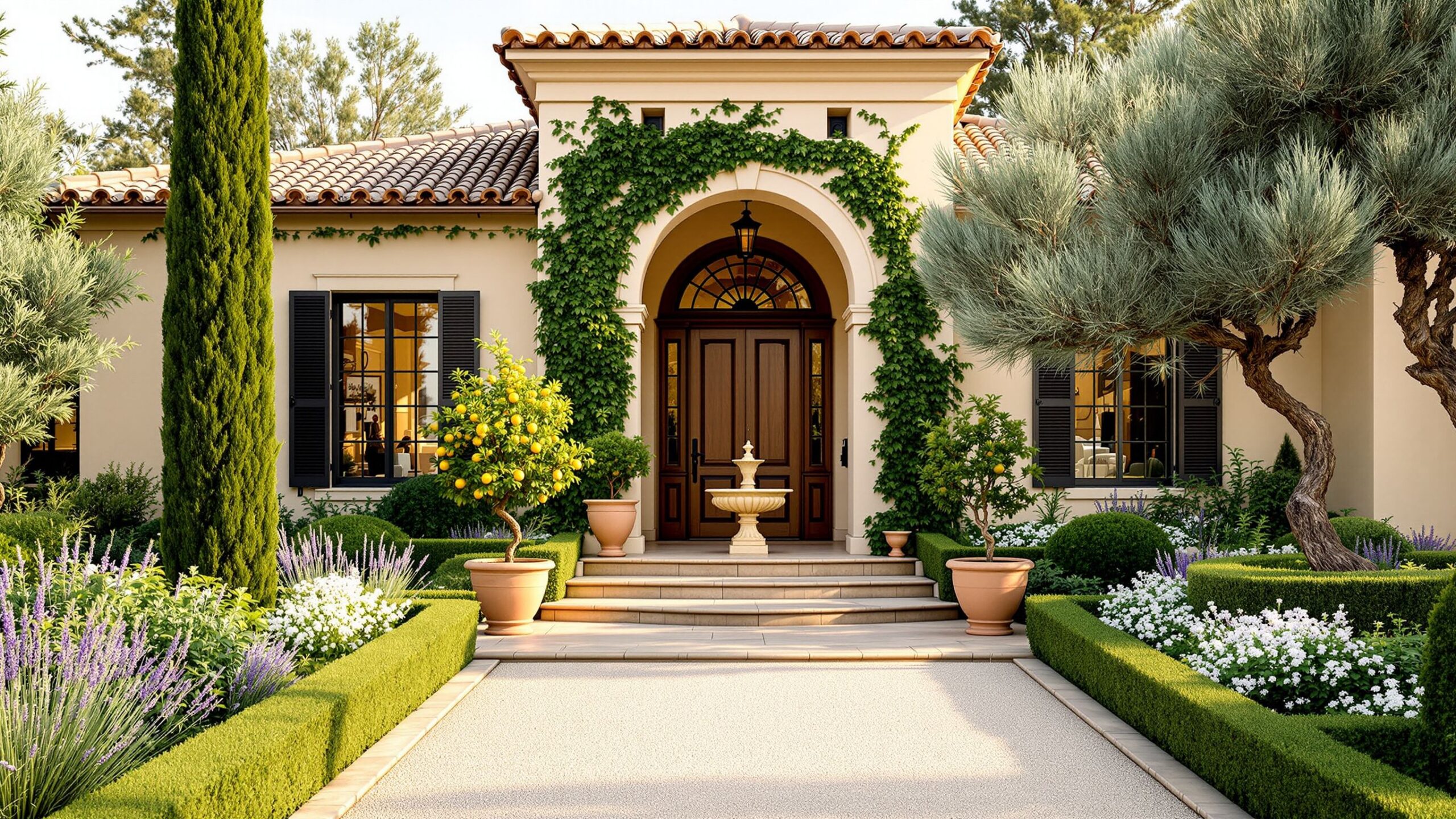
A front garden is one of the easiest places to introduce Italian landscape design because symmetry naturally complements home entrances. Begin with the pathway leading toward the front door and use it as the garden’s primary visual axis. Matching evergreen shrubs, terracotta containers, or narrow upright trees can frame the entrance. Low clipped hedges can define planting beds without blocking views of the house. Gravel can be incorporated around pathways or planting areas, while rosemary, lavender, roses, and other fragrant plants soften the formal structure. If space allows, a small fountain positioned where it can be seen from the entrance can become a beautiful centerpiece. The goal is to make the approach to the home feel intentional, elegant, welcoming, and connected to the architecture.
Creating an Italian Garden in a Small Space
You do not need a sprawling Tuscan estate to create Italian garden atmosphere. Small courtyards and patios can actually be ideal because Italian garden traditions have long embraced enclosed outdoor spaces. Start with a limited material palette, such as warm stone, pale gravel, terracotta, and dark green foliage. Add one strong focal point, perhaps a wall fountain or potted citrus tree. Use climbing plants to cover walls or fences and create vertical greenery without consuming valuable floor space. A small table beneath a vine-covered pergola can transform the area into an outdoor dining room. Symmetrical containers positioned around a doorway can establish formality even when there is little room for permanent planting. The secret is creating richness through texture and composition rather than sheer size.
Designing an Italian Garden for Every Season
Although Italian gardens are strongly associated with sunny summer landscapes, successful garden design considers the entire year. Evergreen hedges, cypress-like trees, architectural stone, fountains, pathways, and sculptures provide structure even when flowers disappear. Spring can introduce roses, flowering vines, and fresh foliage. Summer highlights lavender, herbs, citrus, and shaded outdoor living spaces. Autumn can bring ripening fruit and warmer foliage tones, while winter allows evergreen forms and stone architecture to become more prominent. Homeowners in colder climates should choose plants capable of surviving local conditions and use containers for tender Mediterranean species. Designing around permanent structure ensures that the garden remains attractive even during seasons when relatively little is flowering.
Common Italian Garden Design Mistakes
One of the most common mistakes is confusing Italian-inspired design with simply filling a garden with Mediterranean decorations. Italian gardens depend on structure, proportion, perspective, and relationships between elements. A collection of statues and terracotta pots cannot compensate for poorly planned pathways or overcrowded planting. Another mistake is ignoring climate. Olive trees, Italian cypress, citrus, and other iconic plants may not thrive everywhere, so selecting locally appropriate substitutes can produce better long-term results. Homeowners should also avoid excessive symmetry. Formal balance is important, particularly around entrances and major pathways, but perfect repetition everywhere can become monotonous. Allowing herbs, vines, flowers, and mature trees to soften formal geometry gives the garden warmth and character.
Why Italian Gardens Remain Timeless
Italian gardens remain influential because they accomplish something extraordinary: they make carefully controlled landscapes feel romantic and alive. Architecture establishes order, while plants introduce movement and seasonal change. Stone provides permanence, while water brings sound and reflection. Symmetry creates elegance, while weathered surfaces and climbing vines prevent the landscape from feeling sterile. These contrasts allow Italian gardens to feel both grand and welcoming. Their principles can be adapted to enormous estates, suburban front yards, narrow courtyards, rooftop terraces, and tiny patios. Homeowners do not need to recreate a Renaissance villa to benefit from centuries of Italian landscape wisdom. A pair of terracotta pots, a beautifully positioned fountain, a gravel path, clipped greenery, fragrant herbs, and one shaded seating area can begin telling the same story on a much smaller scale.
Bringing Timeless Italian Beauty Home
The secret behind the timeless beauty of Italian gardens is not any single plant, fountain, or architectural feature. It is the relationship between all of them. Great Italian garden design connects the home to the landscape, establishes clear views, creates destinations, balances formal structure with natural softness, and encourages people to spend time outdoors. Start with strong bones: pathways, evergreen plants, walls, terraces, or carefully positioned containers. Introduce water where possible and use stone, gravel, terracotta, and other natural materials to create warmth. Add fragrant herbs, climbing vines, flowering plants, and trees that respond beautifully to the seasons. Most importantly, design the garden as a place to live rather than simply a landscape to observe. Italian gardens have remained captivating for centuries because they transform outdoor spaces into extensions of everyday life. With thoughtful planning and restraint, even an ordinary home garden can capture a little of that enduring Mediterranean magic.
Garden Product Reviews
Step into Mossy Streets’ Garden Product Reviews — your go-to guide for the best tools, gear, gifts, books, and garden gadgets rooted in nature. From blooming backyard beauties to lush indoor jungles, from heirloom seeds to high-tech composters, we dig into top-rated products for green thumbs, beginners, educators, and plant lovers alike. Whether you’re planting, pruning, decorating, or simply enjoying your green space, we’ve unearthed the best so you can grow, bloom, and thrive — all in one vibrant place!